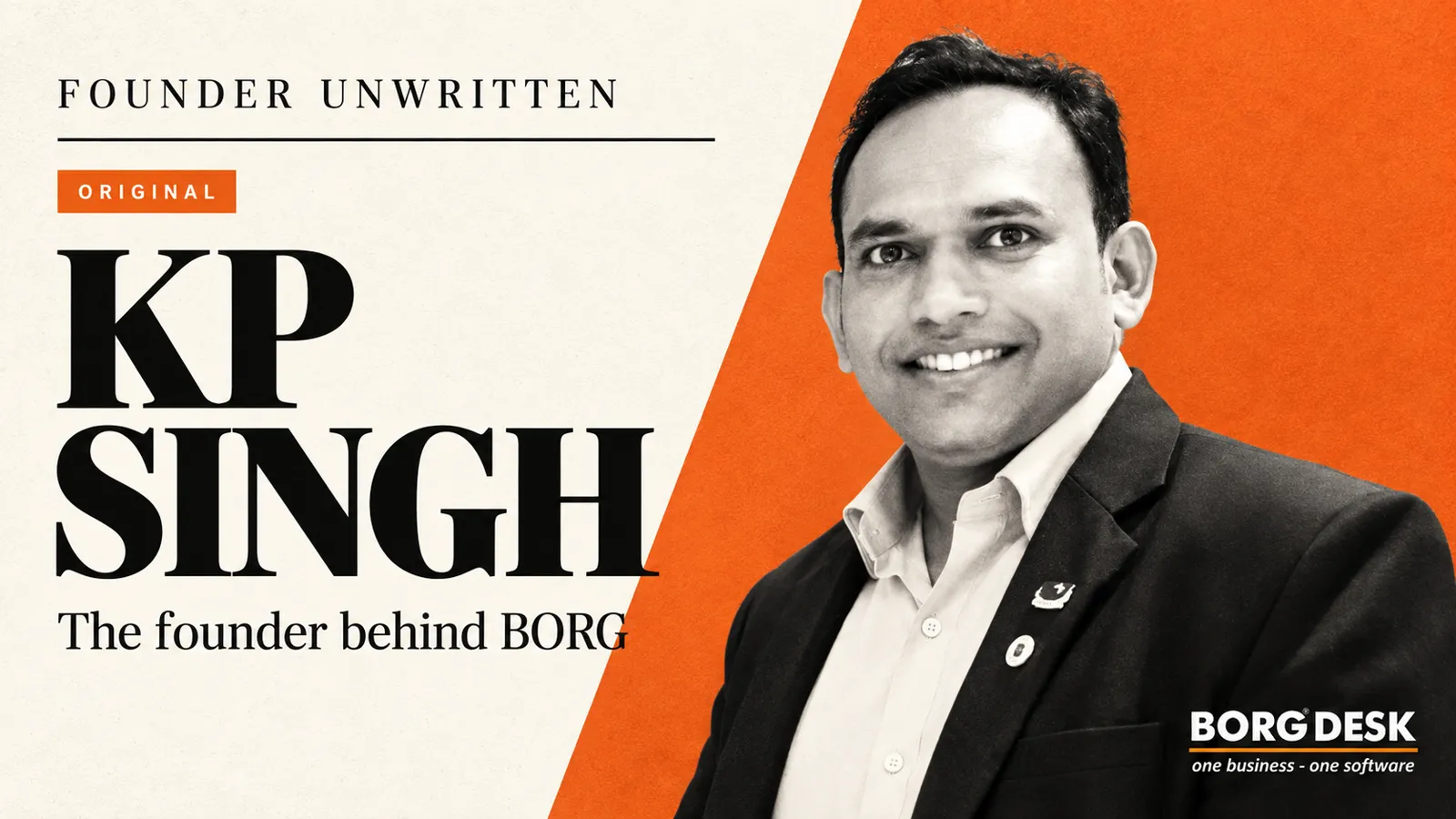
It was a Friday. The developer walked up to K P Singh and said he wouldn't be coming in starting Tuesday.
Four days. That's all the warning he got.
Singh had put everything he had earned into this software product. The developer had built it with him for two and a half years. And now, with this one sentence, he was gone.
“I was literally crying from inside,” Singh says.
He had poured his entire savings into the software, with no backup plan. There wasn't even time to make one.
To understand why that moment hit so hard, we have to go back further.
Singh never planned to build software. He comes from a farming family in western Uttar Pradesh. He finished his engineering degree in 2004 and took his first job at a small IT company in Delhi, as a technical support engineer. Later, he moved to HCL, a bigger name, a safer job, but the whole time, something in him wanted to build his own thing. He just didn't know what.
In 2010, that itch found an outlet. Multi-level marketing was at its peak then, and he leaned toward it as a starting point. He was looking for someone to build a website for him. During that journey, he got another idea: reselling bulk SMS services. That way, he would have some rolling cash to fund the MLM business.
There was one problem. Singh knew nothing about SMS reselling.
He pooled together 1.5 lakh rupees, borrowed from friends. He was newly married then, with very little money of his own. He promised his friends he would double it in five years. That was the bet. And this was kind of an eureka moment for Singh.
The first four or five months gave him nothing. No clients. Most of the money went into registrations, setup and expenses. He was running this business on the side, holding down his day job at the same time, and it was getting harder day by day to do both.
By June 2012, he had only 25,000 rupees left in his account, and his family depended on him. Though this could not stop him from jumping in and continuing.
When the ground disappeared
Then, in October 2012, the ground disappeared beneath his feet.
There was unrest in the northeast part of the country, and the government shut down bulk SMS services nationwide. Nobody knew when or if it would come back. Singh remembers coming home that day soaked in sweat. His mind was racing. What happens if this doesn't restart? How do I feed my family? What do I do now?
He had already burned the bridge back to a regular job and possibly could not return to that. That's when his IT background came in handy.
He registered a new business offering IT services to other companies, hired a trainee, and got moving immediately. There was no other option left.
Through that work, he kept meeting small business owners, mostly in Delhi NCR, running everything off Excel sheets. Those sheets were costing them a lot — deadlines missed, numbers scattered, data sitting in the dark with no one tracking it properly.
Singh saw the gap. These were price-sensitive businesses. They needed something simple and cheap that could hold their whole operation together in one place. That idea became BORG, a cloud-based tool to manage sales, finance, HR, inventory and customer support, all under one roof.
There was just one problem. Singh couldn't code, so he hired someone who could. That developer worked with him for two and a half years, building BORG from nothing, and that was the same man who, one Friday, told him he wouldn't be back after Tuesday.
Becoming the backup plan
This time, there was no one left to lean on. So Singh became that person himself.
He started teaching himself to code. No formal training. Just Google and YouTube, late nights, and whatever patience he had left. He needed to keep the software alive.
“I never back out,” he says.
He never considered giving up and finding another job.
Around then, he ran into an old friend who ran his own software development company. The friend lent him a developer. BORG survived. It grew into a working cloud ERP, the kind of tool Singh had first imagined scribbling notes after client meetings in Delhi NCR, watching business owners drown in spreadsheets they couldn't control.
Today, Singh runs that company without needing any single person to hold it up. He learned that the hard way — on a Friday, with four days' notice, and no one else to call.