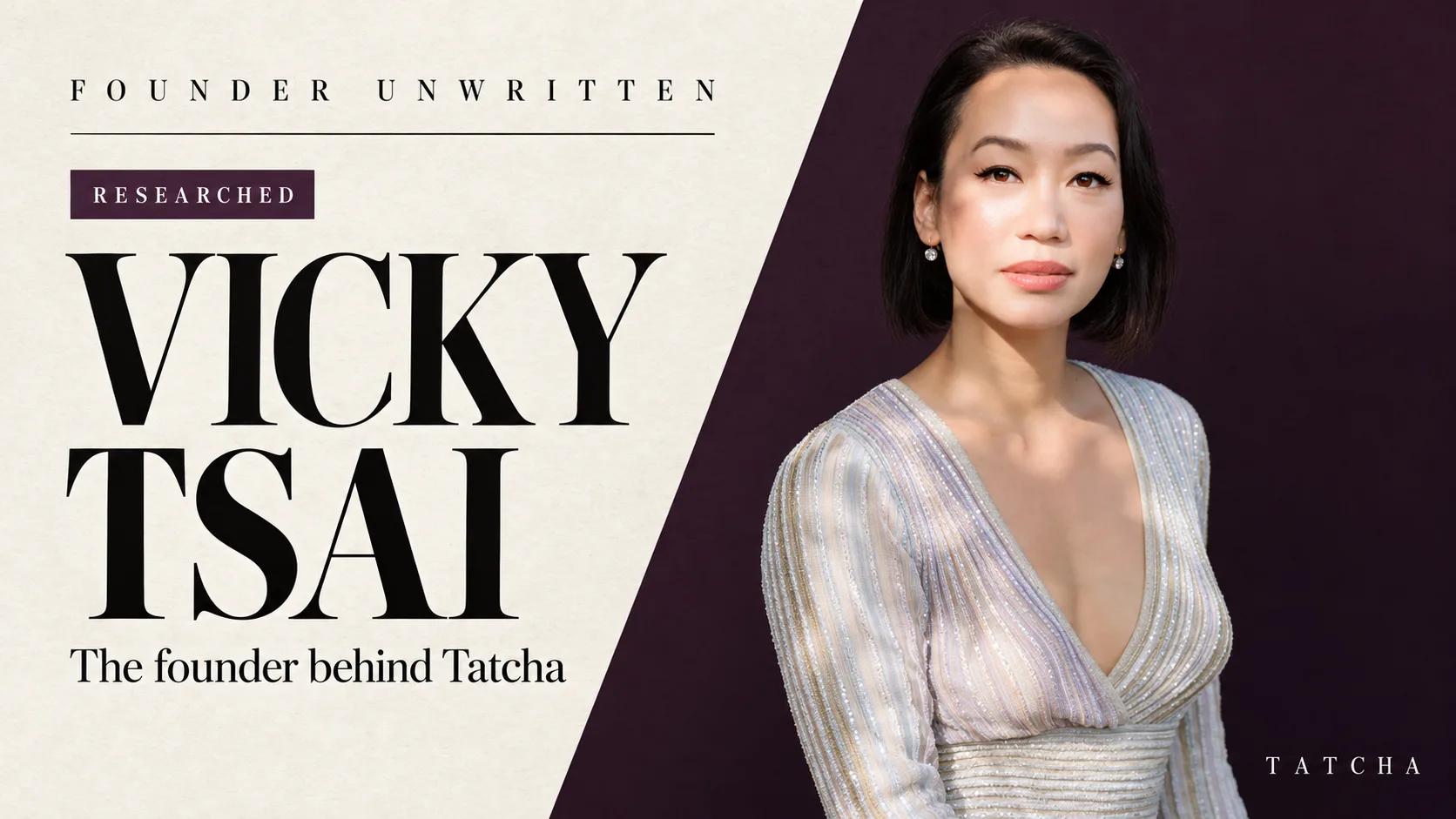
Vicky Tsai left Tatcha twice. The first time, she left because other people made her doubt herself. The second time, she left because she didn't need to prove anything anymore to anyone.
Same decision. Same company. Two completely different reasons. And in between those two exits sits the part of the story nobody put in the headlines.
The First Exit
In 2019, Vicky sold Tatcha, the company she had built over ten years from her garage, to Unilever for a reported $500 million. On paper, it was the ending every founder dreams of. Build it. Sell it. Move on.
But Vicky wasn't so excited about it. She felt like she was losing a part of her life. Tatcha wasn't just a business for her. It was where she'd finally felt accepted, after rough years in corporate America. Her team was her community.
Before the sale even closed, investors had started asking whether she was still the right person to run the company. Not because it was failing. It was growing fast and doing well at Sephora. They just thought it needed a more experienced CEO.
That question hit an old wound. Earlier in her career, someone had told her she lacked leadership potential. She never fully argued with that judgment, but part of her still wondered if she was faking it.
So when investors pushed for "real leadership," she didn't fight. She worried that fighting would make her look like a founder whose ego mattered more than the company.
She stepped aside.
I fired myself.
Once she was gone, Vicky expected the new leaders to teach her something. They had run bigger companies. Surely they knew things she didn't.
Instead, the company started slipping. Tatcha's ranking at Sephora dropped. Growth slowed, even while the skincare market kept growing. Teams lost people. Morale sank.
Then COVID hit. Anti-Asian hate was rising across the country at the same time. Many of Tatcha's employees were Asian women. Vicky could have stayed out of it. She'd already sold the company. Other people had decided they could run it better than she could. None of this was technically her problem anymore.
But these weren't names on a spreadsheet. Some of these employees had worked out of her home in Tatcha's early days. She'd been at their weddings. Sometimes she'd officiated. Their kids and pets had been part of the strange, close world she'd built.
She came back as CEO in early 2021. Coming back was the easy part.
A Company Transformed
The company she returned to wasn't the one she'd left. People had changed. Trust had changed. The business was weaker, and the pandemic made everything harder.
She couldn't just repeat what worked in the early days. Tatcha was bigger now. It needed real systems, stronger leaders, and a culture that could survive even if she left again.
She looked at how other founders had handled coming back. Steve Jobs, Michael Dell, Howard Schultz. Their stories all pointed to the same trap. As a company grows and gets more "professional," it can quietly forget what made it special in the first place.
So she didn't just chase sales. She rebuilt the leadership team. She put the company's original purpose back into daily decisions. She brought in a more diverse group of senior leaders, including Mary Yee, who would later become CEO herself.
It worked. The company came back. But Vicky didn't.
She threw everything into saving Tatcha. Weekends disappeared. Her hours became extreme. She ran her body like it owed the business unlimited fuel.
During the turnaround, she had a miscarriage. Her marriage ended. Years later, she said she'd broken what was left of herself just to finish the job.
This is the part of founder stories we don't like to sit with. We're good at celebrating sacrifice once the company wins. We're less willing to ask if the sacrifice should have been necessary at all.
Give everything to the business sounds noble right up until everything has actually been given.
A successful turnaround doesn't erase a personal loss. Saving the company doesn't automatically make every cost worth it.
If saving the company requires breaking the founder, what did you actually save?
Turning Loss Into Policy
After her miscarriage, Vicky found out Tatcha had no miscarriage leave policy. That shook her. The company had launched around the same time she gave birth to her own daughter. Plenty of her employees were of childbearing age. And there was no real support in place.
She told her team what had happened to her. She apologized to anyone who might have gone through the same loss without ever getting time to recover. Tatcha added a miscarriage leave policy after that.
It couldn't undo what happened to Vicky. But it meant someone else wouldn't have to hide that same pain while showing up to work.
What She Got Wrong
When Vicky first stepped aside, part of her believed the company might have simply outgrown her.
Watching other people run it taught her the opposite. A polished résumé doesn't create good judgment. Experience doesn't guarantee someone will actually care. Professional management can't always protect the reason a company exists.
Two years on the sidelines taught her something years of running the company hadn't. She was never an accidental leader.
The Second Exit
Coming back taught her something else, too. A founder can't be the company's emergency system forever. If every crisis needs the founder to sacrifice her health, her marriage, her life, the company hasn't actually learned to stand on its own.
Eventually, Vicky stepped away from the CEO role again. Mary Yee took over.
This time, the exit looked the same from the outside. But it wasn't. The first time, she left because other people made her question if she was good enough.
The second time, she left after proving she was, and realizing she didn't have to keep proving it forever.
The Story Behind the Story
Vicky Tsai's polished journey is easy to tell. She sold her engagement ring, created Tatcha, built a major beauty brand, sold it for a reported $500 million, and later returned to save it.
Every milestone is impressive. But the more important story sits between those milestones.
It is about a founder who mistook self-doubt for humility. A founder who discovered her own strength only after watching others struggle to replace it. And a founder who saved her company, then had to begin the slower work of saving herself.
Tatcha survived its difficult chapter.
Vicky did too, but survival did not mean returning unchanged.